Open-Cell or Closed-Cell | Which Spray Foam Insulation Is Better for Properties in Utah?
Open-cell and closed-cell spray foam insulation come out of the same gun and do fundamentally different jobs. That surprises a lot of Utah homeowners, who reasonably assume the choice comes down to budget alone. It does not. One expands soft and light to fill awkward cavities and quiet a room. The other cures dense and rigid, blocks moisture, and delivers R-value per inch that nothing else on the market matches.
Picking the wrong one is rarely a disaster, but it usually means paying for performance you did not need, or missing performance you actually did. The difference shows up in the building, not the invoice.
Open-cell vs Closed-cell Spray Foam Compared Side by Side
Numbers make the trade-off clearer than description does.
Neither wins outright, which is precisely the point. The right choice depends entirely on which of those rows matters most in the space being insulated, and that changes from one room to the next inside the same house.
Cost ranges above reflect general industry pricing in the region and are intended for planning only. Thickness applied, access difficulty, and preparation work all move the figure. Final pricing follows an on site assessment.
What Open-cell Spray Foam Does Well and Where It Falls Short
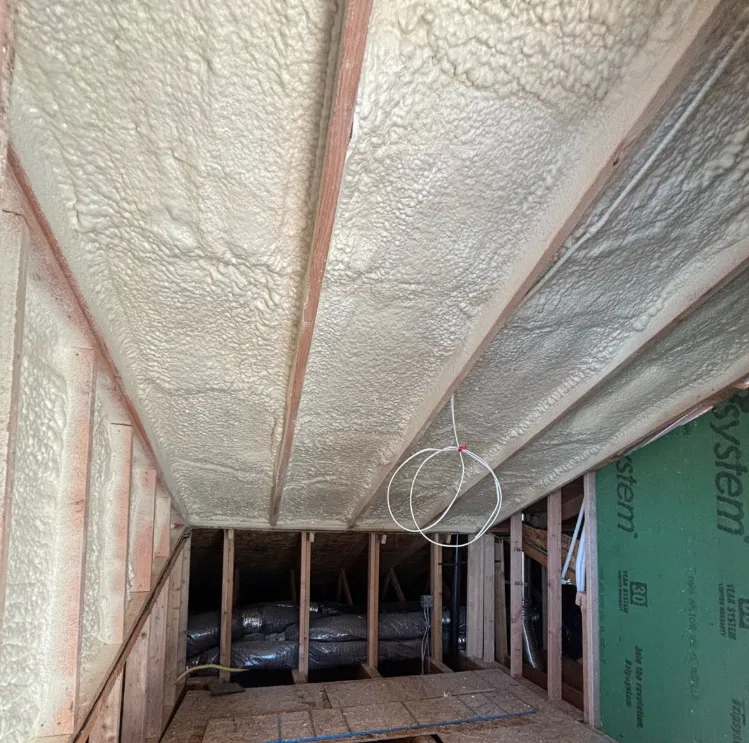
Open-cell foam expands aggressively, roughly a hundred times its liquid volume, then cures into a soft, sponge-like material around half a pound per cubic foot. That expansion is its advantage. It reaches into irregular framing, around wiring, and into awkward corners that batts never manage. It delivers about R-3.5 to R-3.8 per inch, seals air effectively, and dampens sound noticeably better than closed-cell because the open structure absorbs rather than reflects.
It also stays vapor permeable, meaning moisture can pass through it. In the right assembly, that is useful, because trapped water needs somewhere to go. In the wrong one, it becomes a problem.
Why Closed-cell Spray Foam Insulation Costs More and When It Earns It
Closed-cell foam cures dense and rigid, near two pounds per cubic foot, with cells sealed against one another. That structure changes everything. It delivers roughly R-6 to R-7 per inch, nearly double open-cell, which matters enormously where cavity depth is limited.
At sufficient thickness, it acts as both an air barrier and a vapor retarder, stopping moisture rather than letting it pass. It adds measurable rigidity to a wall assembly. It also costs more and offers less sound absorption.
Where does it earn that price? Crawl spaces, rim joists, basement walls, metal buildings, and anywhere moisture control is the actual problem being solved.
Which Spray Foam Suits Attics, Crawl Spaces, and Commercial Buildings
Application decides this more reliably than preference does. In a vented attic with generous depth, open-cell fills the space economically and handles sound well.
In a crawl space or rim joist, where ground moisture is the standing threat, closed-cell is the safer specification nearly every time. Basement walls follow the same logic.
Metal buildings favor closed-cell for its rigidity and condensation control. Interior walls between bedrooms or a home office lean open-cell for acoustic benefit.
What about roof decks? That one depends on ventilation design, and it is a conversation worth having before anyone sprays anything at all.
How to Decide Before You Call Spray Foam Insulation Contractors
Start with the problem rather than the product. A few questions clarify it quickly:
Is moisture the primary concern, or is comfort? Moisture points firmly toward closed-cell.
How much cavity depth is available? Shallow cavities need closed-cell to reach the target R-value.
Is sound control a goal? Open-cell performs noticeably better acoustically.
Is this an interior partition, or an exterior assembly exposed to ground or weather?
What does the existing ventilation design require?
Any contractor quoting a foam type before answering these is selling a product rather than solving a building problem. The assessment should always come first.
Spray Foam Insulation from Whitecap Enterprises in Northern and Central Utah
Whitecap Enterprises installs both open-cell and closed-cell spray foam insulation, which means we have no reason to steer you toward one. We assess the assembly first, looking at moisture exposure, cavity depth, ventilation, and how the space is actually used, then recommend the foam that fits.
Sometimes the answer is closed-cell in the crawl space and open-cell upstairs in the same house. You receive a written quote after the assessment, with the reasoning explained rather than assumed.
Reach out to Whitecap Enterprises and we will look at the building before quoting it.
Frequently Asked Questions
What is the main difference between open-cell and closed-cell spray foam?
Density and structure. Open-cell cures soft and vapor permeable at roughly R-3.5 to R-3.8 per inch. Closed-cell cures rigid and vapor-resistant at roughly R-6 to R-7 per inch, which is why it costs more and performs differently.
Is closed-cell spray foam always the better choice?
No. It is the better choice where moisture control, shallow cavities, or structural rigidity matter. In a deep vented attic where sound absorption is valued and moisture is not a threat, open-cell often delivers better value for the money.
Which spray foam is better for soundproofing?
Open-cell. Its softer, more porous structure absorbs sound energy rather than reflecting it, making it the stronger option for interior partitions, home offices, and rooms where noise transfer is the primary complaint.
Can both types be used in the same house?
Yes, and frequently they should be. Closed-cell in a crawl space or rim joist paired with open-cell in attic or interior walls is a common and sensible specification that matches each material to the conditions it faces.
How much does spray foam insulation cost in Utah?
Industry pricing generally runs $1.50 to $3.50 per square foot for open-cell and $3.00 to $7.00 per square foot for closed-cell. Thickness, access, and preparation drive the final figure, confirmed after assessment.
Whitecap Enterprises provides spray foam insulation services in Pleasant Grove • Lehi Mapleton • Park City • Alpine • Salt Lake City • South Jordan• Draper• Santaquin • Provo • Heber City • Saratoga Springs and surrounding communities across Northern and Central Utah.
